
This is an old revision of the document!
Table of Contents
ChatEHR is a vendor-agnostic, internally governed platform that places the full longitudinal patient record—up to twenty million tokens—directly into a model's context window in real time. It is accessible both through an interface embedded in the EHR (40% usage) and through APIs (60% usage) that automate high-volume rote tasks. This ArXiv submission describes the usage in the first 3 months of launch.
User Interface
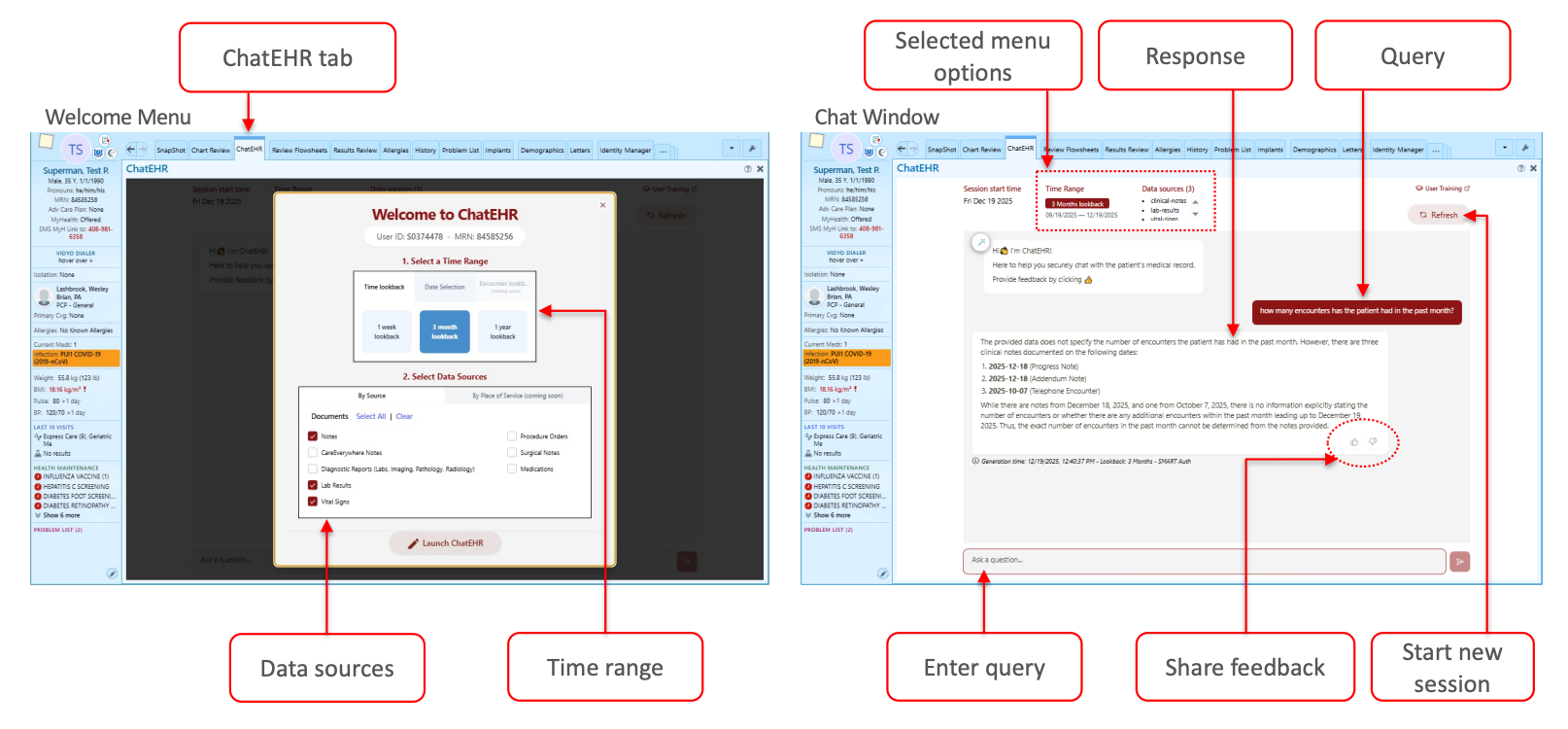
When users open a ChatEHR tab in the EHR, they first see a welcome menu (left) to select which patient data to load into context for the LLM, by selecting data sources and a time range. After launching ChatEHR, they see a chat window (right) where they can submit queries and receive responses, provide feedback (thumbs up/down), or start a new session by returning to the welcome menu.
Testimonials
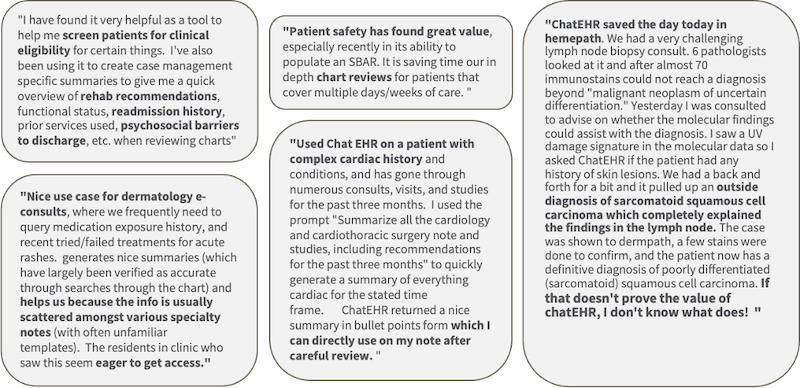
The UI pilot concluded in June 2025, with a total of 150 users, 3000 chat sessions, and dozens of testimonials (below) and led to a full enterprise roll out in Sept 2025. In the first 3 months, 1075 users completed the training video and engaged in over 23,000 sessions with over 19B tokens processed. 180 APPs, 424 physicians, 151 residents, and 60 fellows used the UI at least once in the first 3 months of launch.
Current usage
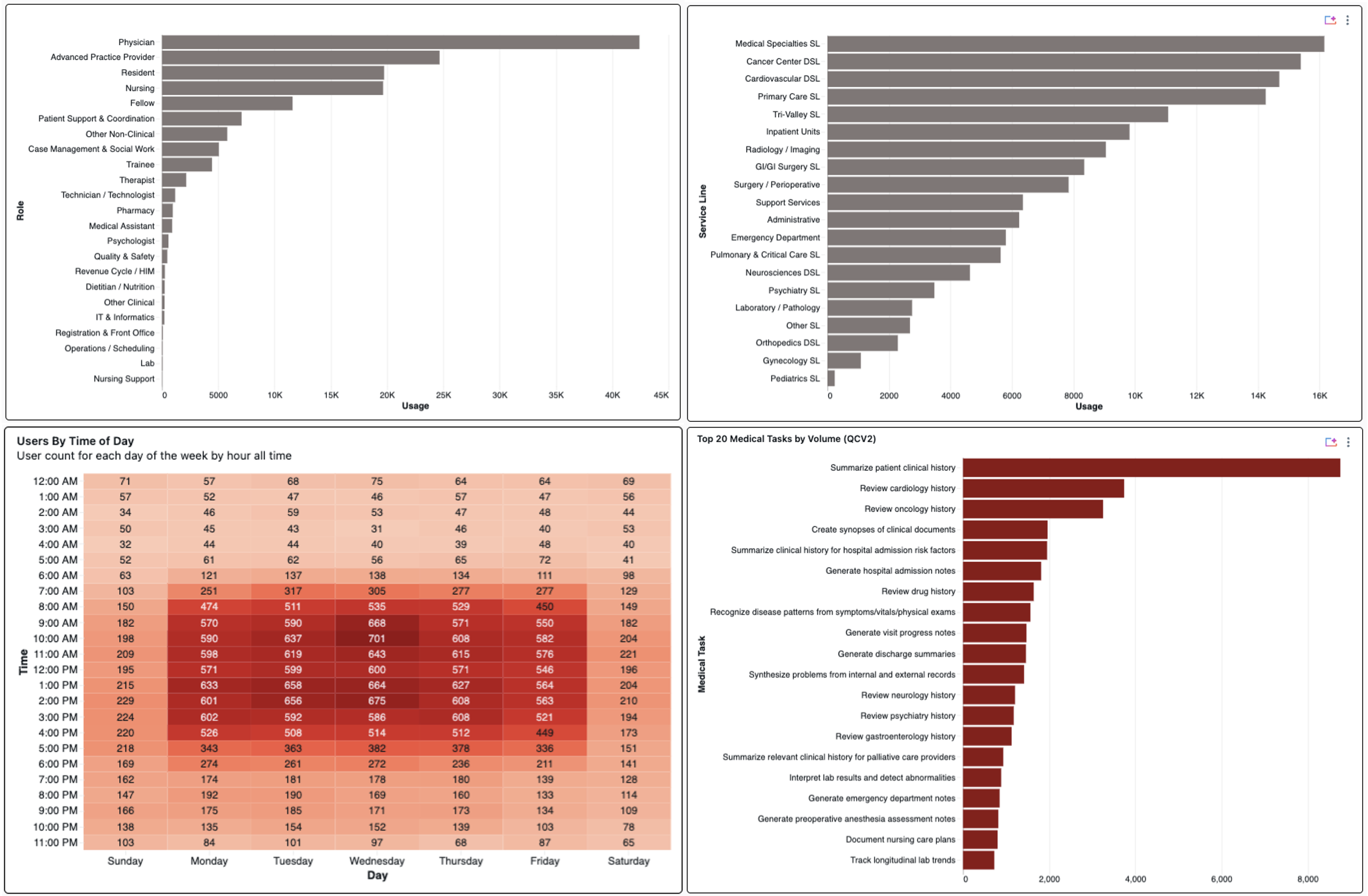
The panels below show current usage as of July 2026. The top left panel shows usage by role and to top right shows usage by service line. The bottom left panel shows usage by time and day of week, and the bottom right panel shows the top 20 tasks performed by the users.
Automations
Automations are fixed prompts applied to defined sets of patients, and performance is quantified using a clinician-curated gold-standard truth set and impact is measured during monitoring. There are seven automations for which information is publicly available.
- Accelerate referral triage in Orthopedics: Every day, the Orthopedics clinic receives nearly 50 referral packets that can range from two to 50-plus pages, incorporating faxed documents, scanned handwritten notes, imaging reports, and more. Manual review to identify diagnoses, prior surgeries, treatment history, and missing information needed for scheduling can take up to 20 to 30 minutes or more per case.
- Review of accounts with an LoA stop bill: Before this automation, PFS teams manually reviewed patient accounts against LoAs — an effort that averaged 10–15 minutes per account, contributing to delays in payment and account finalization.
News coverage
Timeline
- Apr 06, 2023 - Data Science team sets up SHCOpenAISandbox at http://goto.stanford.edu/shcopenaisandbox
- Aug - 2023 - Work begins on setting up securegpt.stanfordhealthcare.org
- Nov 01, 2023 - chatEHR is conceptualized at TDS while building https://securegpt.stanfordhealthcare.org/
- Nov 08, 2023 - A working demo is created by a student as an AI-CARE project.
- Jan 29, 2024 - SecureGPT, launched for Stanford School of Medicine and Stanford Health Care
- Jan - March, 2024 - Proof of concept work in ENT referral and Nursing summarization using SecureGPT.
- May - 2024 - the concept of using an LLM in context with a single patient record is fleshed out
- June 10, 2024 - second demo and prototype
- June 19, 2024 - presentation to Data Science Exec Committee, and permission to build
- July 2024 - First automation use-case implemented to automate chart review for inter-facility transfers
- Aug 15, 2024 - Backend architecture overhaul
- Aug 23, 2024 - Alpha testers get access to the UI
- Jan - 2025 - First user gets access for UI
- June 5, 2025 - Announcement of the pilot, with 30+ active users
- July 2, 2025 - Ramp up to 89 users (clinicians, nurses, residents, fellows, PAs, care managers, MD students)
- Aug 1, 2025 - Pilot ramped up to ~150 users, and closed new enrollment into the pilot
- Sept 9, 2025 - Broad roll out to all providers, and APPs.


