
This is an old revision of the document!
Table of Contents
ChatEHR is a vendor-agnostic, internally governed platform that places the full longitudinal patient record—up to twenty million tokens—directly into a model's context window in real time. It is accessible both through an interface embedded in the EHR (40% usage) and through APIs (60% usage) that automate high-volume rote tasks. This ArXiv submission describes the usage in the first 3 months of launch.
Automations
Automations are fixed prompts applied to defined sets of patients, and performance is quantified using a clinician-curated gold-standard truth set and impact is measured during monitoring. There are seven automations for which information is publicly available.
- Streamline patient screening, which turns a 5 to 20 minutes chart review into near-real-time eligibility insights. Each day the automation narrows 150 patient charts to roughly 30 highly probable cases reducing screening time and helping appropriately fill SN1’s 24 beds, relieve capacity pressure, and get patients to the right care setting faster.
- Identify patients for medical co-management during surgery, which replaces a time-consuming, variable manual process with a scalable daily workflow that helps hospitalists focus on the surgical patients most likely to need support—improving efficiency and care coordination across neurosurgery, orthopedics, and ENT.
- Enhanced surveillance of surgical site infections, which helps quality teams prioritize cases, reduce manual review burden, and improve the timeliness and accuracy of infection reporting—with a scalable path from colorectal surgery to 27 additional procedures. It reduces the number of patients charts needing a manual review by 40%.
- Referral triage at the Enterprise Contact Center, which classifies urgency and pre-fills key data for more than 1,000 daily referrals. The Enterprise Contact Center cut handling time by 17.7%, increased throughput by 17.8%, and reduced its backlog from about five to two business days—accelerating patient access while freeing staff to focus on exceptions.
- Identify eligibility for Inpatient Hospice, which narrows roughly 600 patient charts to 10–40 potentially eligible cases. The inpatient hospice automation makes possible a review that current staffing could not sustain—avoiding approximately 18–20 hours of work each day while enabling earlier clinician assessment and more timely, family-centered hospice conversations.
- Accelerate referral triage in Orthopedics, which transforms complex orthopedic referral packets into standardized, Epic-integrated summaries. The automation has processed more than 4,700 documents and saves at least 1.7 staff hours each day—accelerating triage and scheduling while improving consistency and freeing staff to resolve missing information.
- Review of accounts with an LoA stop bill, which automatically compares Letters of Agreement with billing data and writes match indicators and validation notes into Epic. This automation reduces a 10–15-minute-per-account manual review across hundreds of cases and millions in receivables, thus accelerating account resolution, reducing interpretation errors, and lowering downstream underpayment-recovery costs.
User Interface
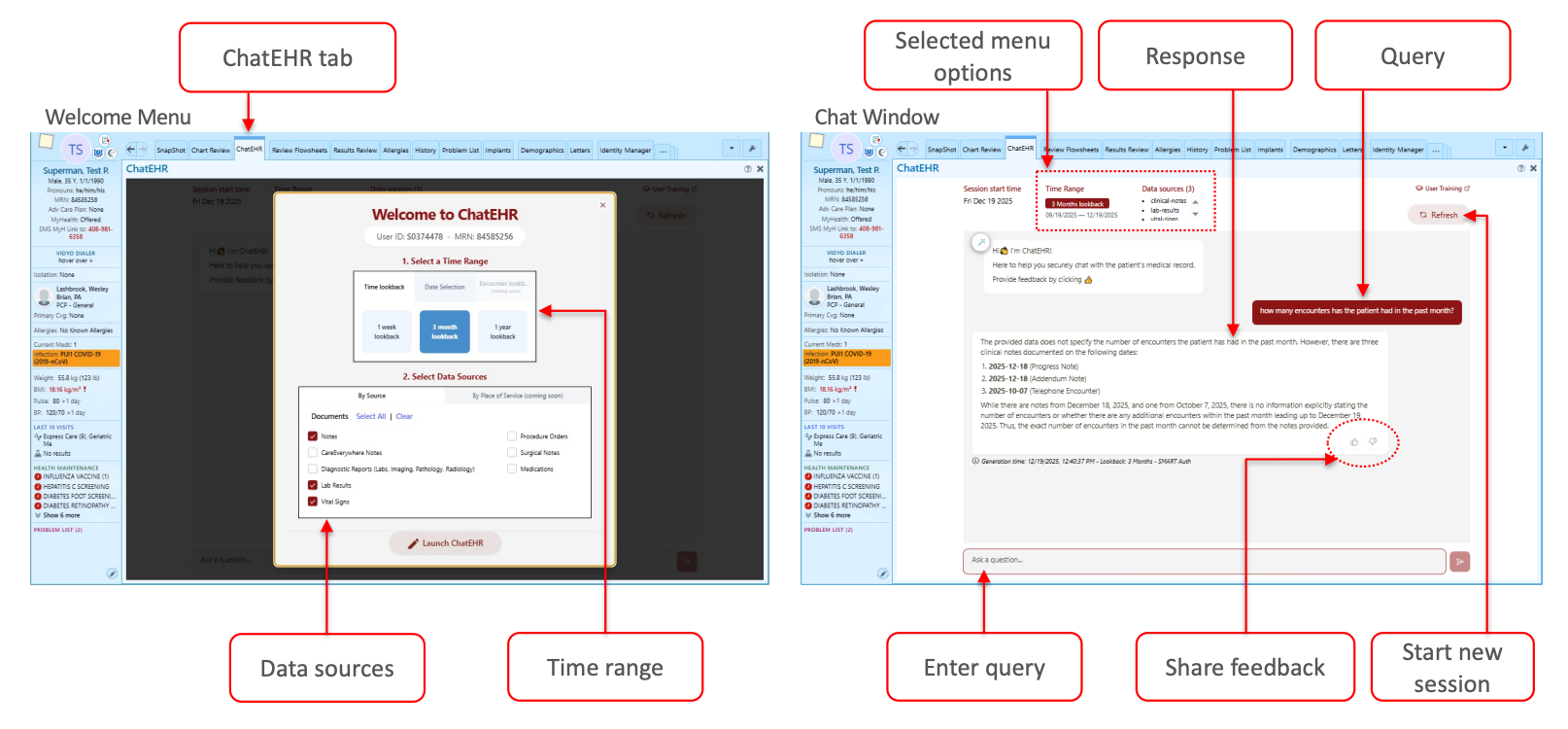
When users open a ChatEHR tab in the EHR, they first see a welcome menu (left) to select which patient data to load into context for the LLM, by selecting data sources and a time range. After launching ChatEHR, they see a chat window (right) where they can submit queries and receive responses, provide feedback (thumbs up/down), or start a new session by returning to the welcome menu.
Testimonials
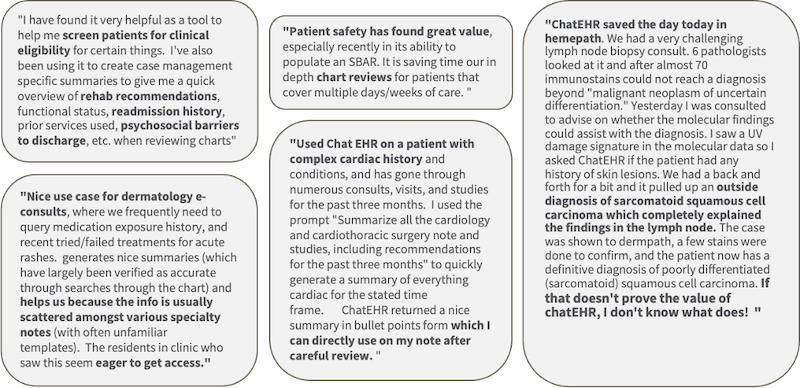
The UI pilot concluded in June 2025, with a total of 150 users, 3000 chat sessions, and dozens of testimonials (below) and led to a full enterprise roll out in Sept 2025. In the first 3 months, 1075 users completed the training video and engaged in over 23,000 sessions with over 19B tokens processed. 180 APPs, 424 physicians, 151 residents, and 60 fellows used the UI at least once in the first 3 months of launch.
Current usage
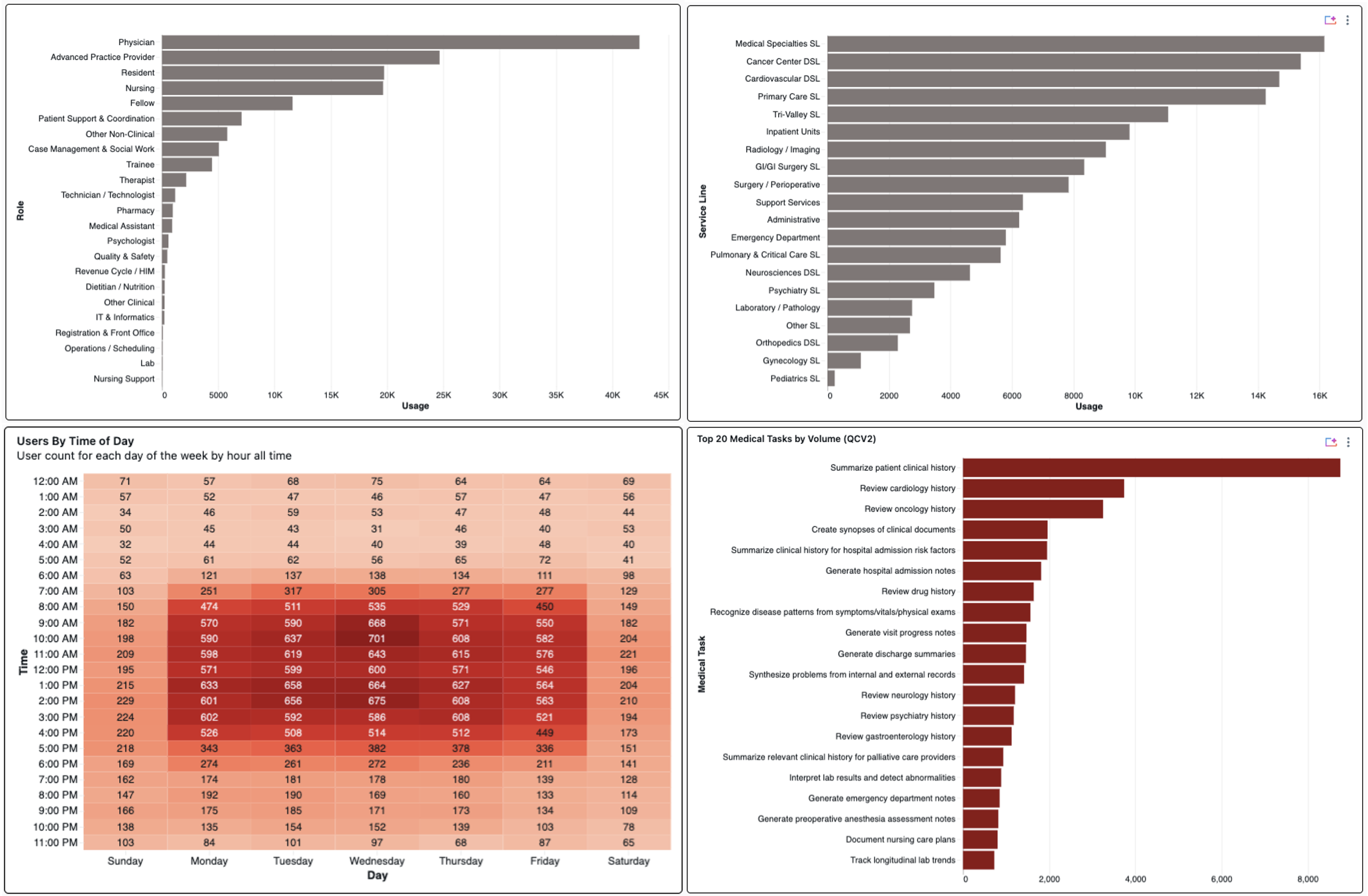
The panels below show current usage as of July 2026. The top left panel shows usage by role and to top right shows usage by service line. The bottom left panel shows usage by time and day of week, and the bottom right panel shows the top 20 tasks performed by the users.
Our Journey
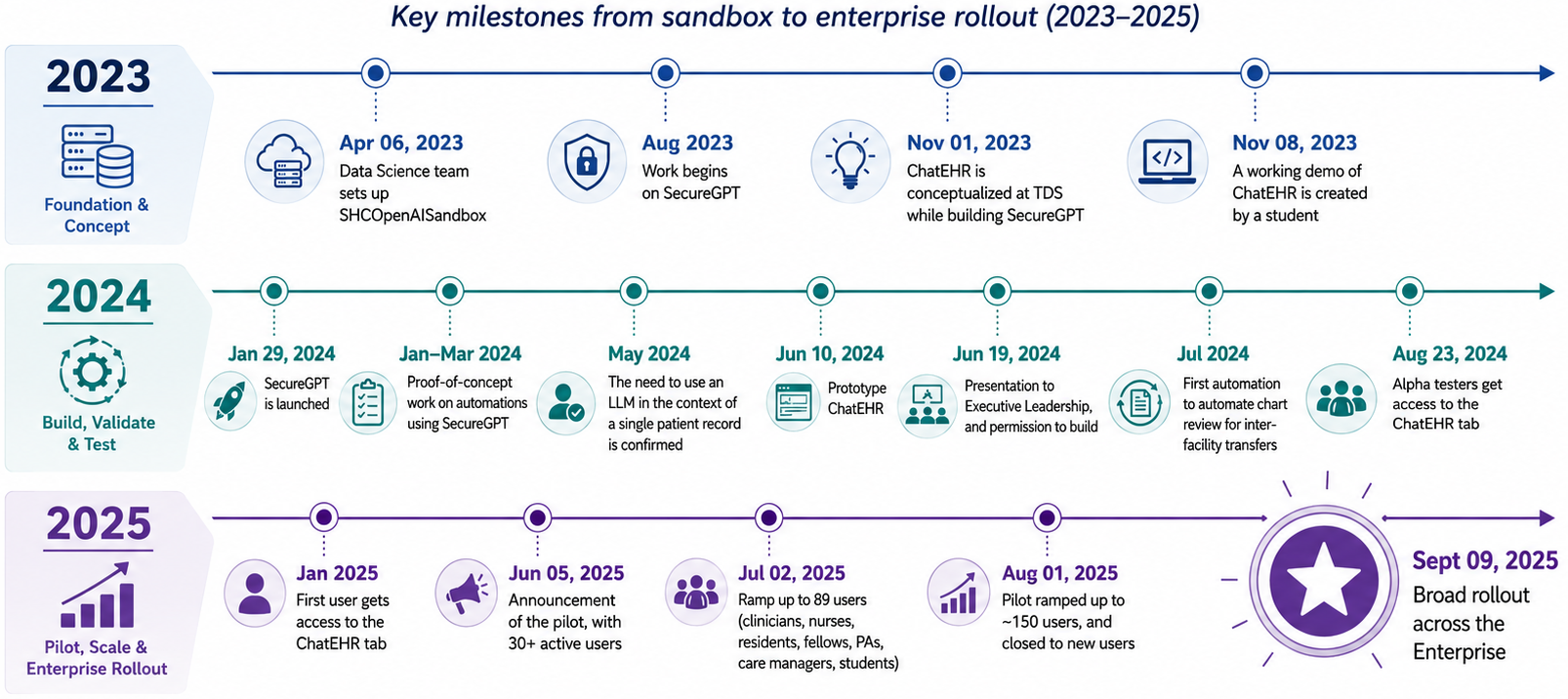
ChatEHR was made possible by embedding the data science team, which includes software engineers, product managers, and data scientists with direct access to academic researchers, in the IT organization. Because of this set up, what began as a sandbox in April 2023 was conceptualized as ChatEHR in November 2023, underwent multiple prototypes by mid-2024, leading to a pilot in early 2025 that scaled to 150 clinical users by August 2025, and a health system-wide roll out by September 2025.
News coverage


