
Table of Contents
ChatEHR is a vendor-agnostic, internally governed platform that places the full longitudinal patient record—up to twenty million tokens—directly into a model's context window in real time. It is accessible both through an interface embedded in the EHR (40% usage) and through APIs (60% usage) that automate high-volume rote tasks.
- Nature Medicine has a 3 page, human readable article.
- ArXiv as a 45 page, agent friendly technical report.
Automations
Automations are fixed prompts applied to defined sets of patients. Across seven operational workflows, these automations convert high-volume, repetitive review into focused, actionable work embedded in the EHR. They help place patients in the right care setting, identify surgery cases who may need medical co-management, strengthen infection surveillance, accelerate referral triage, surface patients who may benefit from inpatient hospice, standardize complex orthopedic referrals, and validate billing accounts.
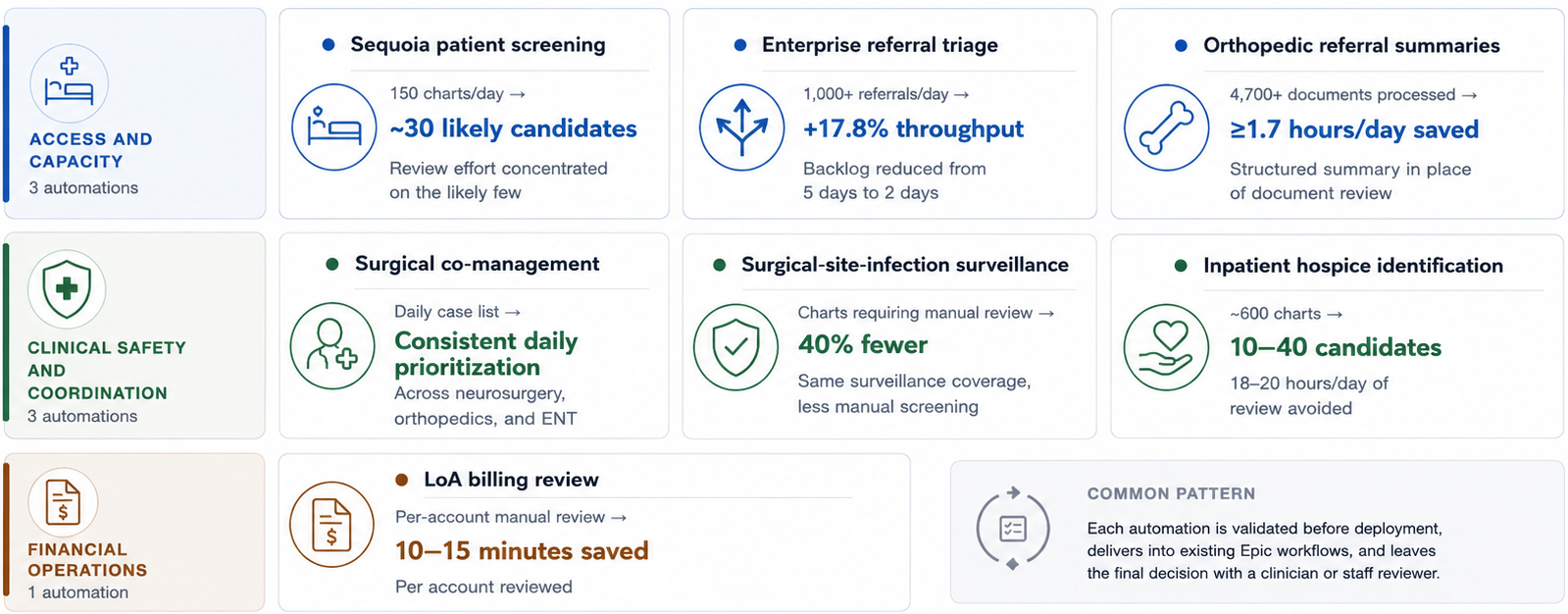
- Streamlined patient screening turns a 5 to 20 minutes chart review for 150 patient charts to roughly 30 highly probable cases.
- Identifying patients for surgical co-management lets hospitalists focus on the right neurosurgery, orthopedics, and ENT patients.
- JAMA Netw Open paper by Wang et al, of a prospective study of ChatEHR to accurately augmented surgical patient triage.
- Surveillance of surgical site infections reduces chart review by 40%, and improves the timeliness of infection reporting.
- Referral triage at the Contact Center, cuts time by 17.7%, raises throughput by 17.8%, and reduced backlog from five to two days.
- Identifying eligibility for Inpatient Hospice, screens 600 patient charts to find 10–40 eligible cases to avoid 18–20 hours each day.
- Accelerated referral triage in Orthopedics, processes over 4,700 documents and saves at least 1.7 staff hours each day.
- Review of accounts with an LoA stop bill, saves 10–15 min/account per resolution and lowers underpayment recovery cost.
User Interface
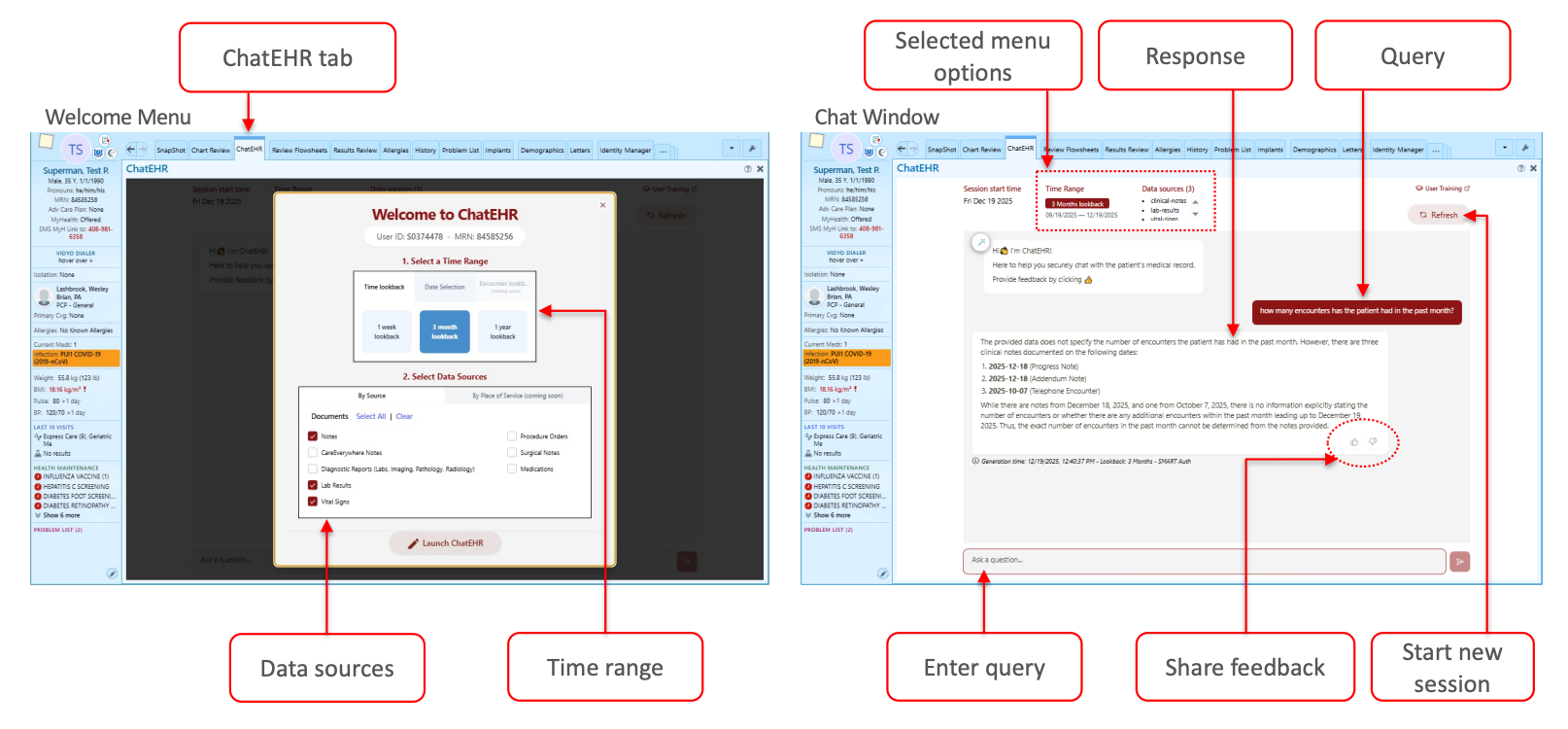
When users open a ChatEHR tab in the EHR, they first see a welcome menu (left) to select which patient data to load into context for the LLM, by selecting data sources and a time range. After launching ChatEHR, they see a chat window (right) where they can submit queries and receive responses, provide feedback (thumbs up/down), or start a new session by returning to the welcome menu.
Testimonials
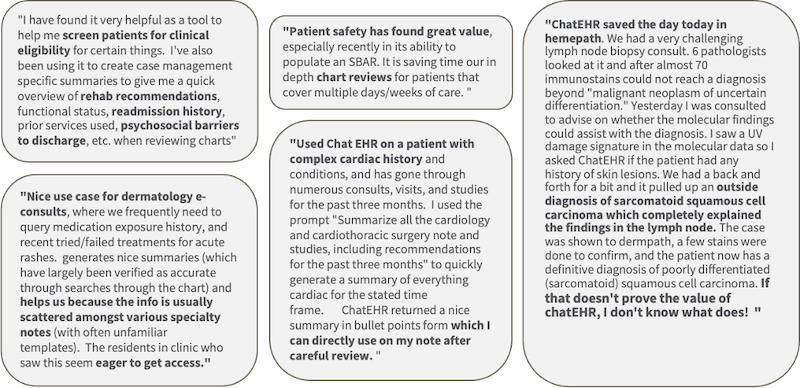
The UI pilot concluded in June 2025, with a total of 150 users, 3000 chat sessions, and dozens of testimonials (below) and led to a full enterprise roll out in Sept 2025. In the first 3 months, 1075 users completed the training video and engaged in over 23,000 sessions with over 19B tokens processed. 180 APPs, 424 physicians, 151 residents, and 60 fellows used the UI at least once in the first 3 months of launch.
Current usage
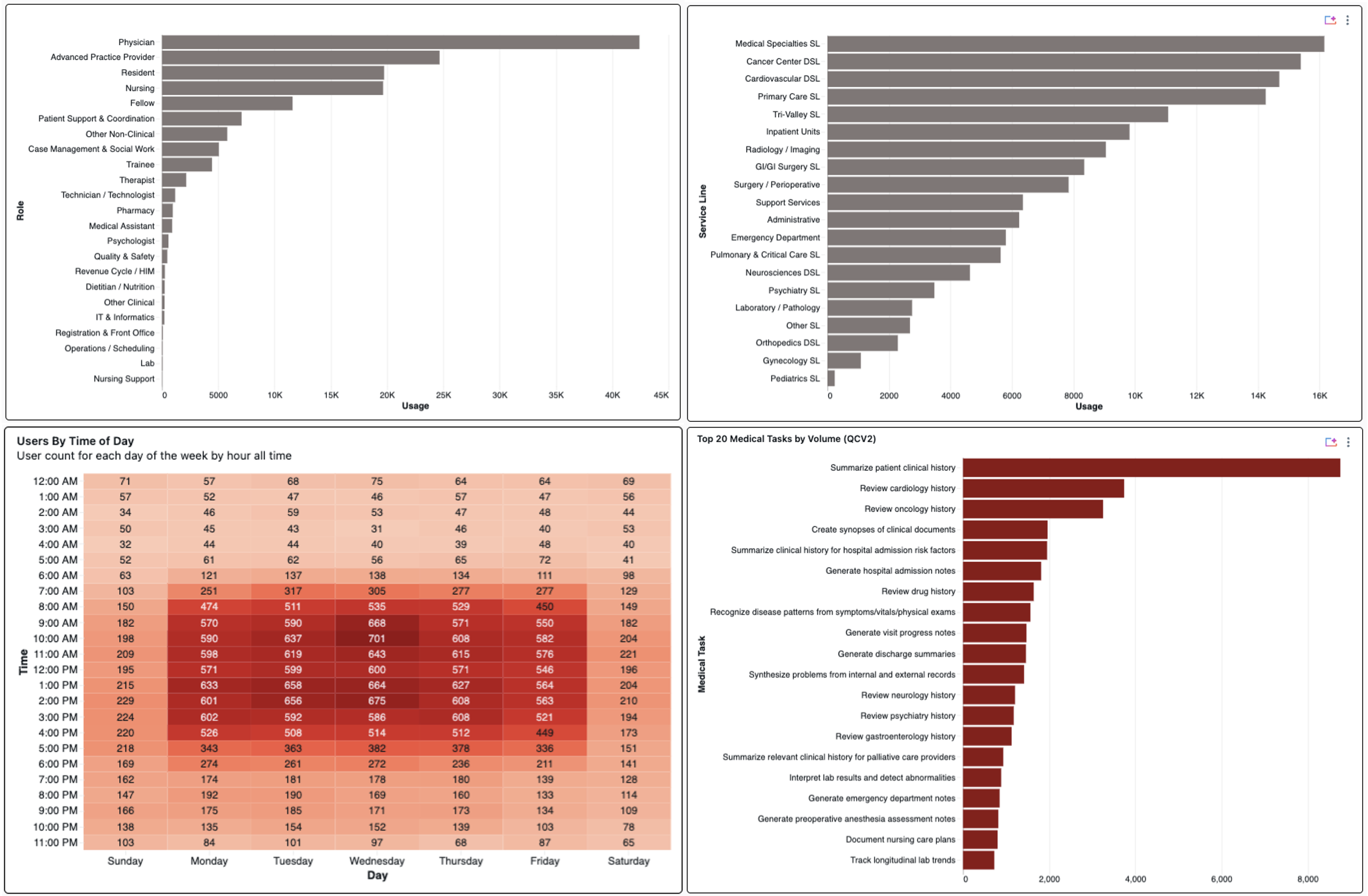
The panels below show current usage as of July 2026, with 3400+ active users, 150,000+ sessions, and 140B tokens processed. The top left panel shows usage by role and to top right shows usage by service line. The bottom left panel shows usage by time and day of week, and the bottom right panel shows the top 20 tasks performed by the users.
Our Journey
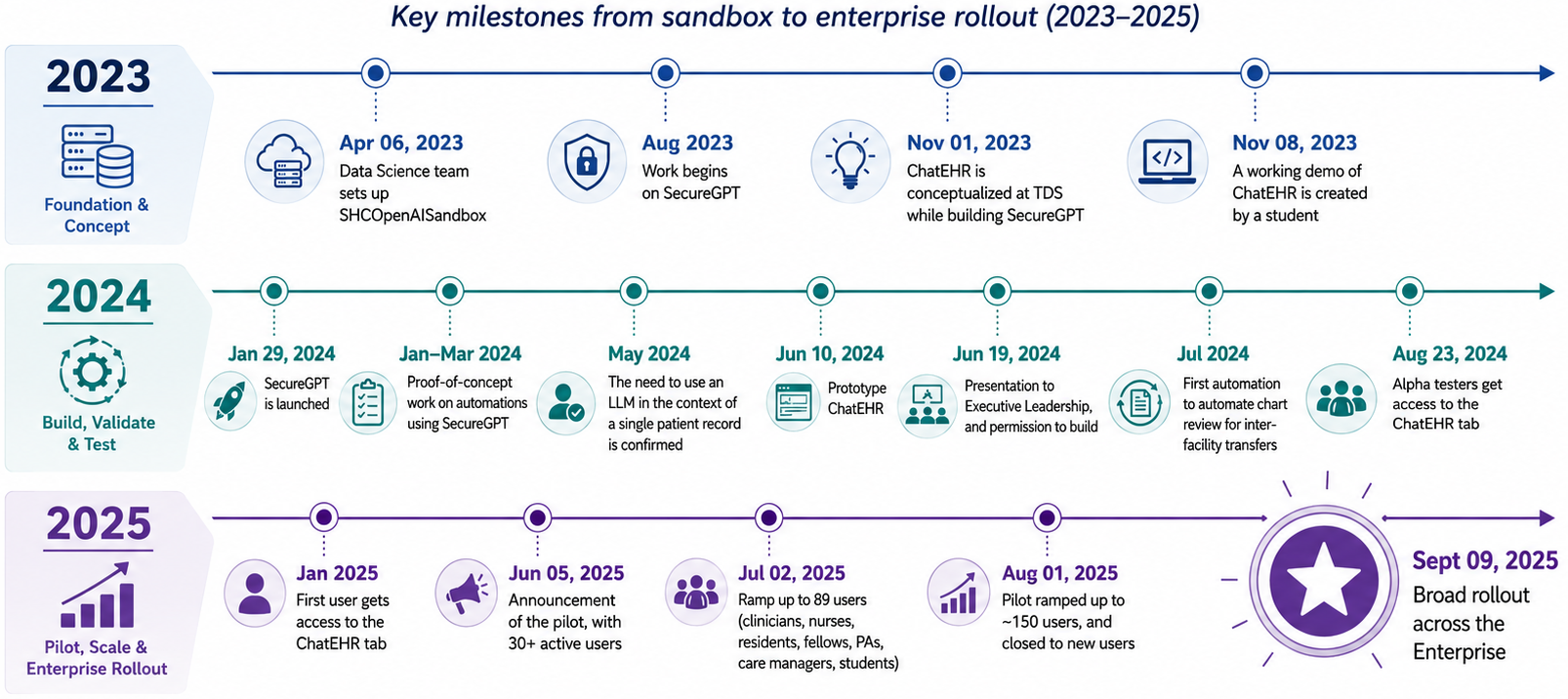
ChatEHR was made possible by embedding the data science team, which includes software engineers, product managers, and data scientists with direct access to academic researchers, in the IT organization. Because of this set up, what began as a sandbox in April 2023 was conceptualized as ChatEHR in November 2023, underwent multiple prototypes by mid-2024, leading to a pilot in early 2025 that scaled to 150 clinical users by August 2025, and a health system-wide roll out by September 2025.
News coverage


